
So, you're curious about BDSM. Good. You've come to the right place, and you're definitely not alone.
At its core, BDSM is really all about empowered, consensual exploration. It’s built on a bedrock of trust, communication, and mutual pleasure. Forget the stereotypes—this isn't about abuse or real danger. It’s about people choosing to explore fantasies and power dynamics together in a safe, pre-negotiated space.
Your First Step Into the World of BDSM

Think of this as your starting point for understanding a world that’s often misunderstood. The acronym "BDSM" is just an umbrella term that covers a huge range of activities and interests. It breaks down into three main, often overlapping, categories:
- Bondage & Discipline (B&D): This is all about using physical restraints (like ropes or cuffs) and agreed-upon rules or playful punishments. It's a game with structure.
- Dominance & Submission (D&s): This side of things is more psychological. It’s about one person consensually taking on a controlling role (the Dominant) while another agrees to a more yielding role (the submissive).
- Sadism & Masochism (S&M): This is about the erotic exchange of intense sensations, often perceived as pain. The sadist enjoys giving these sensations, and the masochist enjoys receiving them, all for shared pleasure.
Despite what you might see in movies, BDSM is far more common than people think. Recent studies estimate that a staggering 40-70% of adults worldwide have fantasized about BDSM. This growing awareness is helping to tear down old stigmas, making it so much easier for curious newcomers to explore without feeling judged. If you want to dive deeper, you can find out more about these global BDSM statistics and trends.
The Foundational Mindset
To make sure every experience is a positive one, the BDSM community lives by a few core ethical principles. Think of them as the guardrails that keep everything fun, respectful, and secure.
What’s the line between BDSM and abuse? Enthusiastic, ongoing consent. It’s an agreement built on trust where the person in the submissive role ultimately holds the power to stop everything at any moment.
Getting these frameworks down is non-negotiable before you ever start playing. They create the safe container for everything that follows. The two most important principles are:
- SSC (Safe, Sane, and Consensual): This is the classic BDSM mantra. "Safe" means taking steps to prevent physical and emotional harm. "Sane" means everyone involved is clear-headed and understands what they're doing. "Consensual" means everyone has given an enthusiastic "yes!"
- RACK (Risk-Aware Consensual Kink): This is a more modern take. RACK acknowledges that no activity is ever 100% risk-free. The focus here is on identifying potential risks, talking about them openly, and making informed decisions together.
Adopting this mindset from the very beginning creates a welcoming, judgment-free space. It confirms that your curiosity is completely normal and reminds you that BDSM is a vast world with plenty of room for gentle, psychological play that anyone can enjoy. For more reading on this and other topics, you can explore our sex education articles.
The Unbreakable Foundation: Consent, Safety, and Communication

If BDSM were a building, these three concepts—consent, safety, and communication—would be its steel-reinforced foundation. They aren't just good ideas or helpful suggestions. They are the absolute, non-negotiable requirements for any ethical and rewarding experience. Getting a handle on these is the single most important thing you'll do on this journey.
Think of it like planning a challenging mountain climb. You wouldn't just show up and start scrambling up the rocks. You'd discuss the route (your scene), check your gear (safety protocols), and agree on signals for when you need to slow down or stop (safewords). That prep work is what makes the adventure both thrilling and safe.
Enthusiastic Consent: The Only "Yes" That Matters
Consent in BDSM is so much more than a simple "yes" uttered once. Real consent has to be enthusiastic, informed, and ongoing. It's a living agreement that can be pulled back at any moment, for any reason, with no questions asked. Silence is not consent. Hesitation is not consent. A reluctant "I guess" is definitely not consent.
What we're looking for is a vibrant, clear-eyed "hell yes!" It means everyone involved knows exactly what they're getting into and is genuinely excited to be there. This isn't a checkbox you tick once; it's a conversation that keeps going.
In any BDSM dynamic, the person in the submissive or receiving position holds the ultimate power. They have the ability to stop the entire scene cold, making their enthusiastic participation the most crucial element in the room.
To keep consent clear, you need tools for communication established before the fun even starts. This is where safety measures come in, giving everyone an unambiguous way to manage the experience as it happens.
Unbreakable Safety Protocols: Your Essential Toolkit
Safety in BDSM is about protecting both the physical and emotional well-being of every single person involved. It’s about creating a space where you can push boundaries and explore fantasies without causing actual harm. The cornerstone of this is the safeword.
A safeword is a pre-agreed word or phrase that has no business being in the scene's context, which makes it impossible to mistake for anything else. When someone says it, everything stops. Immediately. No exceptions, no "just one more minute."
For more detailed communication in the heat of the moment, many people rely on the simple but effective traffic light system:
- Green: "I'm good! This is great, and you can even ramp it up if you want."
- Yellow: "Okay, ease up. I'm getting close to a limit or feeling a bit uncomfortable, but I don't want to stop entirely just yet."
- Red: This is a safeword. It means "Stop everything right now."
Using these tools isn't a sign of weakness—it's the hallmark of a healthy, trusting dynamic. They empower everyone to explore with confidence, knowing a reliable safety net is always there.
The Constant Flow of Communication
Communication is the glue that holds all of this together. It’s not just one talk; it's a continuous process that happens before, during, and after any kind of play. Without it, consent becomes murky and safety is put at risk.
This ongoing conversation naturally breaks down into three key phases:
- Negotiation (Before): This is your planning session. You talk openly about desires, fantasies, hard limits (things you will absolutely never do), and soft limits (things you might be open to with caution). This is also when you lock in your safewords and discuss what aftercare will look like.
- Check-ins (During): The conversation doesn't end when the scene starts. Use the traffic light system, but also pay close attention to body language and non-verbal cues. Even a simple, whispered "You okay?" can ensure everyone is still on the same page.
- Aftercare (After): This is the cool-down. After an intense scene, the rush of adrenaline and endorphins can fade, leaving people feeling emotionally vulnerable—a feeling often called "sub drop" or "dom drop." Aftercare is the practice of providing comfort and support to help everyone feel safe and grounded. It can be cuddling, talking, sharing a snack, or just quietly being present for each other.
To help you keep these critical ideas straight, here's a quick reference guide to the fundamental principles every beginner must know before engaging in any BDSM activity.
Core Safety and Communication Frameworks
| Concept | What It Means | Example in Practice |
|---|---|---|
| Enthusiastic Consent | A clear, ongoing, and excited "yes" from all participants. | Instead of asking "Is this okay?", try asking "How much do you want this?" |
| Negotiation | The detailed discussion of desires, limits, and safety before a scene. | Creating a shared checklist of "yes," "no," and "maybe" activities with your partner. |
| Safewords | Pre-agreed words (e.g., "Pineapple") that immediately stop all activity. | Your partner says "Pineapple," and you instantly stop, remove restraints, and ask "Are you okay?" |
| Traffic Light System | A graded system (Green, Yellow, Red) for in-scene communication. | During a scene, your partner says "Yellow," so you reduce the intensity and check in verbally. |
| Limits (Hard/Soft) | Clear boundaries. Hard limits are non-negotiable, soft limits are flexible. | A hard limit might be "no face slapping." A soft limit could be "light hair pulling is okay." |
| Aftercare | Emotional and physical support provided after a scene to ensure well-being. | Cuddling under a warm blanket, drinking water, and talking about the experience afterward. |
Embracing these concepts as a complete framework builds the trust necessary for genuine exploration. It's what transforms a potentially intimidating activity into a profoundly connected and mutually rewarding experience for everyone involved.
Getting to Know BDSM Roles and Common Kinks
Diving into BDSM is a bit like learning a new language, and roles are the grammar that holds it all together. But don't mistake these for rigid identities or personality boxes. Think of them more like parts you play in a scene—you might be the hero one night and the villain the next, all depending on the story you and your partner want to tell.
At its core, BDSM is about a consensual exchange of power. These roles just give that exchange a structure, creating a safe framework for partners to explore different dynamics. The best part? You're never locked in. What feels right today might be completely different tomorrow, and that fluidity is a huge part of the journey.
The Core Power Dynamics
Most of the roles you'll come across fall into a few common pairings. Getting a feel for the differences is a great first step in figuring out what resonates with you. Many people find they naturally lean one way, but plenty of others enjoy bouncing between them.
- Dominant (Dom) & submissive (sub): This classic pairing is all about psychological power. A Dom finds satisfaction in taking charge, setting the rules, and giving commands. A sub, on the other hand, finds pleasure and freedom in giving up that control and following their Dom's lead.
- Top & bottom: These terms are more about the physical act itself. The Top is the person doing the action—like spanking, tying ropes, or using a flogger. The bottom is the one receiving that action. A Dom is often a Top, but not always. A sub can even be a Top in certain scenarios (think a bratty sub "forced" to spank their Dom).
- Switch: Just like it sounds, a Switch is someone who genuinely enjoys both sides of the coin. They might play a Dom one day and a sub the next, or even shift from Top to bottom within a single scene, depending on their mood and their partner.
Exploring these roles is a deeply personal process. There's no right or wrong way to identify. The goal is simply to discover what dynamics create the most connection, trust, and pleasure for you and your partner.
It's also worth noting that the BDSM community is incredibly diverse, welcoming people of every gender and orientation into these roles. In fact, an international survey found that relationship styles like open relationships (22.2%) and relationship anarchy (9.6%) are far more common than in the general population, showing just how open the community is to different ways of connecting. You can dig deeper into the data by reviewing the full BDSM practitioner survey.
Gentle Introductions to Common Kinks
Once you have a handle on the roles, you can start exploring the actual activities, or kinks. As a beginner, it’s smart to start with gentle, accessible concepts that help you build trust and communication before you dive into anything too intense. Here are four common categories of kinks that are perfect for newcomers.
1. Bondage (Restraint Play)
This is all about restricting movement to heighten other senses and create a delicious sense of vulnerability. Forget what you've seen in the movies; you don't need complicated gear to start.
- How to start: Grab some silk scarves or soft ties and loosely bind your partner's wrists to the headboard. The focus isn't on intricate knots, but on the sensation of being held and the powerful anticipation it creates.
2. Impact Play (Sensory Play)
Impact play involves consensual striking for pleasure. It sounds intense, but it can range from a light, teasing tap to a firm, rhythmic spank. The sensation can release a flood of endorphins and forge a powerful connection.
- How to start: Your own hands are the best beginner tool. A few light, open-handed spanks on the bottom are an incredibly intimate and powerful introduction. It lets you get instant feedback and gauge your partner's reaction in real time.
3. Sensation Play (Texture and Temperature)
This type of play is all about waking up the nerves with different feelings. It's a fantastic way to explore sensitivity and touch without getting into heavy intensity.
- How to start: Use a blindfold to take away sight and amplify your partner’s sense of touch. Then, gently trace their skin with different objects: a soft feather, a cool ice cube, or the smooth, cold back of a spoon.
4. Roleplay (Psychological Play)
Roleplay is where you get to bring fantasies to life by creating a story. This is less about physical acts and more about the psychological thrill of stepping into different characters within an agreed-upon power dynamic.
- How to start: Try a simple, low-stakes teacher/student scenario. The "teacher" can give gentle commands or playful "assignments," while the "student" gets to enjoy the fun of following the rules. It’s all about the dynamic, no special equipment needed.
Planning Your First Scene and Setting Boundaries
Okay, you’ve got the core principles down. Now it’s time to move from theory to practice. I know planning your first scene can feel like a huge, intimidating step, but I find it helps to think of it as co-writing a short, fun script with your partner. This isn’t about creating rigid rules; it’s a creative collaboration meant to build trust and make sure everyone has an amazing time.
The whole point is to create a clear blueprint for your experience. When you talk everything through beforehand, you get rid of the guesswork and create a space where you can both relax and just be in the moment. Honestly, the more detailed your "script," the more confident you'll both feel heading in.
Step 1: Brainstorm Your Desires and Limits
This first step is all you. Before you even sit down with your partner, take some quiet time to think about what you’re actually curious about. What roles are calling to you? Which of the kinks you've read about genuinely spark your interest? You're not making a final decision here, just gathering some initial ideas.
Just as important is figuring out your boundaries. In the BDSM world, we call these limits. You have to be brutally honest with yourself about what sounds genuinely exciting versus what just makes you uncomfortable. This self-awareness is the bedrock of any healthy negotiation.
Step 2: Have the Negotiation Conversation
Alright, time to bring your ideas to the table. This conversation is the absolute heart of planning a scene. It’s where you and your partner openly share your desires, curiosities, and—most crucially—your limits.
A "yes, no, maybe" framework is a fantastic way to structure this chat:
- Yes List: These are the activities you’re both genuinely excited to try.
- No List (Hard Limits): These are your non-negotiables. Think of them as absolute, no-go zones that must be respected without question or pressure.
- Maybe List (Soft Limits): These are things you might be open to, but maybe under certain conditions or once you have more experience. It’s totally normal for this list to be long—it just shows areas you can explore together down the road.
Step 3: Choose a Simple First Activity
For your first time out, start small and simple. I can't stress this enough. Your main goal here is to practice communicating and build confidence, not to stage some elaborate, movie-worthy production. A fantastic first experience usually hones in on a single, low-intensity activity.
A beginner's first scene isn't a final performance; it's a rehearsal. It's an opportunity to practice your communication, test your comfort levels, and learn how to navigate a dynamic together in a low-pressure environment.
Consider starting with something like light bondage using silk scarves, paired with some sensory play like a blindfold. This combo is gentle, doesn’t require a ton of gear, and is incredibly effective for building intimacy and trust.
This flow chart breaks down how different elements—like the roles you take on, the dynamic you're creating, and the activities you choose—all fit together.
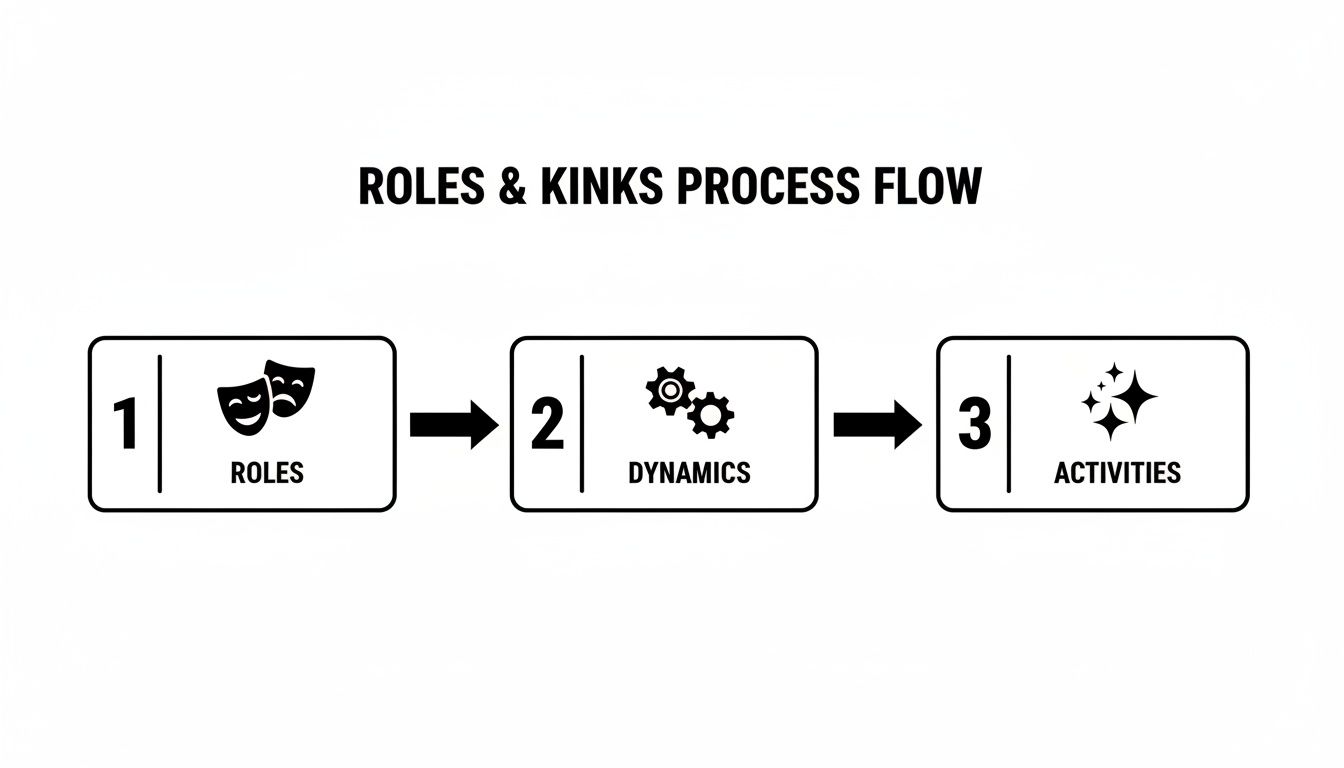
As you can see, a successful scene is built by layering these concepts, starting with the roles you both agree to play.
Step 4: Finalize Your Safety Plan
Once you’ve picked an activity, it’s time to lock in your safety protocols. This is the final, non-negotiable check before you play. Reconfirm your safeword and make sure you both understand that "red" (or whatever word you choose) means everything stops. Immediately. No questions asked.
If you’re exploring something like anal play, for example, ensure you’re set up for success with the right techniques and products. For anyone curious, you can get the full rundown in our guide on how to prepare for anal play.
Finally, talk about aftercare. What will each of you need afterward to feel safe, grounded, and connected? Plan to have water, snacks, and a cozy blanket ready. Agreeing on this beforehand ensures the transition out of your scene is smooth and supportive for everyone involved.
Essential Aftercare for Emotional Wellbeing

The scene might be over and the toys put away, but the experience isn't truly complete. We need to talk about aftercare—the gentle, crucial transition back to the real world. Think of it as the emotional cool-down that’s just as vital as the negotiation that kicked everything off.
During a scene, your body gets flooded with a powerful cocktail of endorphins and adrenaline. It feels amazing. But when that rush fades, the comeback can be rough, leading to a sudden emotional crash. This is what people in the community call “sub drop” for the submissive or “dom drop” for the dominant. It can leave you feeling surprisingly sad, anxious, or just plain fragile.
Aftercare is the non-negotiable solution to this emotional hangover. It’s all about grounding yourselves, reconnecting as people, and stepping out of your roles. It’s a powerful way to reinforce that your connection is built on genuine care, far beyond the power dynamics you just explored.
Designing Your Perfect Aftercare Menu
Here’s the thing: aftercare isn’t one-size-fits-all. What feels comforting to one person might not work for another. That's why you hash this out during your initial negotiation, creating a personalized "menu" of comforting activities you can turn to when the scene ends.
Putting this plan together beforehand is a game-changer. It means you don't have to scramble to figure things out when you're both feeling emotionally raw and vulnerable. Support becomes instinctual and immediate.
Not sure where to start? Here are some common ideas that work wonders:
- Physical Connection: Sometimes, all you need is a simple touch. Gentle cuddling, holding hands, or just lying together under a warm blanket can be incredibly grounding.
- Verbal Reassurance: Talk it out. Softly sharing what you both enjoyed, offering words of praise, or just saying "thank you" goes a long way in rebuilding that person-to-person connection.
- Basic Needs: Bring yourselves back to basics. Sharing a snack, sipping on water or warm tea, or taking a shower together can help you settle back into your bodies in a gentle, nurturing way.
- Quiet Comfort: After an intense scene, peace and quiet can be the best medicine. Just being together in silence, listening to calm music, or putting on a favorite comfort movie can be deeply restorative.
Aftercare isn't a suggestion; it's a fundamental part of the BDSM experience. It signals the true end of a scene and honors the emotional trust that was shared between partners, ensuring everyone feels valued and secure.
The Deeper Impact of Emotional Safety
Putting such a strong emphasis on aftercare reveals a deeper truth about BDSM. For many, it's not just a physical act but a path to profound emotional connection and stress relief. This focus on emotional wellbeing is critical, especially as BDSM continues to be better understood as a healthy, consensual practice. Research shows that many people evolve from exploring in private to engaging with the public community—a journey that absolutely requires strong emotional support systems. You can learn more about how BDSM practice is viewed in a modern context and its journey away from being classified as a disorder.
Ultimately, aftercare is the final, loving bookend to any scene. By planning for it, you're making a direct investment in your own emotional health and that of your partner. It’s this commitment to caring for the whole person that turns a simple activity into a deeply connecting and sustainable practice.
Choosing Your First BDSM Toys and Gear
Walking into a sex shop or browsing online for BDSM gear can feel overwhelming. Walls of whips, endless types of restraints, and gadgets you can't even name... where do you even begin?
Take a deep breath. You don't need a fully stocked dungeon to get started. The best approach is to start soft and simple. Focus on a few key items that align with the kinks you and your partner are most excited to explore.
Think of your first toys as tools for communication and discovery, not a massive financial investment. Remember, the most powerful instruments in any scene are your words, your hands, and the trust you've built. Gear just adds a little extra spice.
Starting with Bondage Gear
When you're new to bondage, the goal is creating a delicious sense of vulnerability, not mummifying your partner. You can often achieve this with things you already have lying around the house. The key is to use soft, easily removable materials that feel good against the skin.
-
Soft Restraints: Forget complicated rope for now. Silk scarves or even soft fabric ties are perfect for beginners. They're gentle on the wrists and ankles and can be untied in a flash, making them fantastic for practicing communication while building confidence.
-
Blindfolds: A simple satin blindfold is probably one of the most potent BDSM tools you can buy. Taking away sight heightens every other sensation—a gentle touch, a whispered word, the crinkle of a toy—and builds incredible anticipation.
First Steps in Impact Play
Impact play is all about consensual, rhythmic sensation, and it doesn't have to be intense. The idea is to explore that endorphin-releasing feeling of light impact in a safe, controlled way. And guess what? Your best starting tools are already attached to your arms.
The human hand is the ultimate beginner's impact toy. It gives you instant feedback—you can feel the force of the smack and the temperature of your partner's skin, making it incredibly intuitive to control the intensity.
When you feel ready for a dedicated tool, look for something with a wide, flat surface. This distributes the sensation rather than concentrating it into a sharp sting. A soft, flexible silicone paddle is a great first choice, as it often makes a satisfying thud sound without being too intense.
Exploring Sensation Play
Sensation play is an amazing gateway into BDSM because it’s all about exploring different textures, temperatures, and feelings on the skin. It’s incredibly versatile and can be dialed up or down, making it perfect for your first scenes.
-
Feathers and Faux Fur: Gently tracing a feather or a piece of faux fur across a blindfolded partner's body can create wonderfully ticklish, nerve-tingling sensations.
-
Ice Cubes: The sudden, sharp shock of cold from an ice cube offers a thrilling contrast to warm skin. It wakes up the nerve endings in a completely new and exciting way.
The Non-Negotiable Essentials
No matter what kind of play you're getting into, two items are absolutely non-negotiable for safety and hygiene: a high-quality lubricant and a proper toy cleaner.
Keeping your gear clean is a fundamental part of BDSM safety, preventing infections and making sure your investments last. And a good lube is essential for comfort and pleasure, especially any time toys are involved. If you're looking to explore more advanced gear like harnesses, you can learn more in our guide to the best strap-on harnesses.
Got Questions? Let's Talk.
It's totally normal to still have a few things rattling around in your head, even after getting the basics down. Think of this as your quick-reference guide for those common "what if" and "how do I" questions that everyone has when they're starting out.
Let's cut right to the chase and clear up some of the biggest curiosities.
"Is BDSM Just Abuse?"
This is the big one, and the answer is a hard no. The line in the sand between BDSM and abuse is enthusiastic, ongoing consent. It's that simple. Abuse is a violation, an act of harm without agreement.
BDSM is the polar opposite. It's an entire world built on a bedrock of trust, open communication, and shared pleasure. Every single thing that happens in a scene—every touch, every word, every tool—is talked about and agreed upon before you even start.
You could say that in BDSM, the person in the "submissive" role actually holds all the cards. They have the power to stop everything with a single word, making their consent the most important element in the room.
"How Do I Find My People?"
Finding others who share your interests is probably easier than you think. The community is generally very welcoming to newcomers who are respectful and eager to learn. A great first step for many is checking out kink-friendly dating apps, where you can be open about your interests right from the start.
But for a real-world connection, look for local "munches." These are super casual, no-pressure meetups in public spots like a coffee shop or a quiet bar. Munches are perfect for meeting people, asking questions, and just getting a feel for the local vibe without any expectation of play. Online forums and educational groups on social media are also fantastic places to connect and learn from a distance.
Remember, whenever you meet someone new, your safety comes first. Always make the first meeting in a public place and be crystal clear about your boundaries from day one.
"Can I Do This By Myself?"
Absolutely! In fact, exploring solo is a fantastic, safe way to start this journey. It gives you the space to figure out what you're into without any pressure or self-consciousness. It's all about learning your own responses at your own speed.
Here are a few ideas to get you started with solo play:
- Self-Bondage: Don't think of complicated knots. Start with soft scarves or ties you can easily get out of. The goal is to feel the sensation of light restraint, not to actually trap yourself.
- Sensation Play: This is all about exploring touch. See how your skin reacts to different things—a soft feather, an ice cube, a rough piece of fabric. It’s a great way to map out what feels good to you.
- Trying on Gear: Simply wearing something like a blindfold or a collar can be a powerful psychological experience. It helps you understand how these items feel and what they might represent to you.
Flying solo is an empowering way to build self-awareness. That self-knowledge will make you a much more confident and communicative partner down the line, should you choose to play with others.
"What If My Partner Isn't Into It?"
This is a tough spot, and it's a common one. The only way through it is with open, honest, and completely non-judgmental communication. When you bring it up, frame it as a personal curiosity—something you want to explore—rather than a critique of them or what you already share.
Try sharing resources that can help demystify BDSM for them, like this very guide. It can help clear up common misconceptions. You could also suggest starting with something incredibly light, like using a blindfold during sex, just to test the waters.
But here’s the most important part: you have to respect their answer. If your partner is just not interested, you can't push them. Forcing or coercing someone into kink is the exact opposite of consent, which is the whole point. At that stage, you have to have an honest conversation with yourself about whether this difference is a deal-breaker for the relationship.
At Pleasure Trunk, we believe everyone deserves to explore their desires safely and confidently. Whether you're starting solo or with a partner, we offer a curated selection of beginner-friendly toys and gear to help you on your journey. Explore our collections and start your adventure today at https://www.pleasuretrunk.com.
0 comments